How to Play Vita Mahjong
The full rule set explained plainly: which tiles you are allowed to take, what counts as a match, how the five layers work — and a board on this page to try it on.
Updated
What Vita Mahjong is, and what it is not
Vita Mahjong is a single-player tile game, not the four-player gambling game of the same family. Players sometimes call this format mahjong solitaire, Shanghai, or taipei. One person plays, there are no turns, no opponents, and no stakes.
A full board holds 144 tiles arranged in stacked layers. The goal is to remove every tile by taking them away two at a time, and the game ends either when the board is empty or when no legal pair is left anywhere on it.
Almost nothing from four-player mahjong carries over. There are no hands, no discards, no wall to draw from, and no scoring for particular combinations. The two games share their tile art and very little else, which is why the solitaire format is catalogued separately from the tile game it borrowed its faces from.
How to play Vita Mahjong: the whole rule set
The complete rules fit in four lines. Everything else in this guide is a consequence of them rather than an addition to them.
- Tiles leave the board in matching pairs, never one at a time.
- A tile can be taken only when no other tile rests on top of it.
- A tile can be taken only when its left or its right long edge is clear.
- You have won when all 144 tiles are gone.
Players who lose their first few boards almost always know all four already. Knowing which tiles are legal is a different skill from knowing which of the legal ones to take.
Which Vita Mahjong tiles you are allowed to take
A tile is available only when two conditions hold at once. Nothing may rest on top of it, and either its left or its right long edge must be clear. A tile with neighbours on both sides is locked even when nothing covers it.
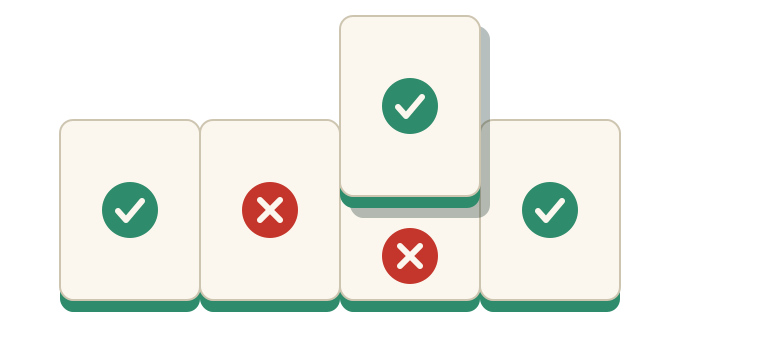
Clear means the whole long edge, not part of it. Stacked layouts often set a tile half a width off its neighbour, and that half-overlap still blocks: there is no gap wide enough to slide the tile out sideways.
This single rule drives the whole game, so the habit worth building from the first game onward is to look at a tile’s neighbours before you look at its face. Whether two faces match is the easy question. Whether either tile can actually be lifted is the one that decides the board.
What counts as a match in Vita Mahjong
Two tiles are removed together when their faces are identical. The three numbered suits run one through nine in characters, bamboo and circles, and every one of those faces appears four times in a set. Winds and dragons behave the same way: east matches only east, and the red dragon matches only the red dragon.
Two groups break the identical-face rule. The four flower tiles all match each other, and the four season tiles all match each other. A plum can therefore be cleared with an orchid even though the pictures differ, which is also why those eight are the matches players most often walk straight past.
The arithmetic matters more than it looks. Four copies of a face means two pairs, so the deal itself never orphans a tile. You can orphan one, though, by clearing two copies off an open edge while the other two sit buried under a stack that only those copies would have opened.
- Characters 1–9
- 36
- Bamboo 1–9
- 36
- Circles 1–9
- 36
- Winds
- 16
- Dragons
- 12
- Flowers
- 4
- Seasons
- 4
- Whole board
- 144
How the layers of a Vita Mahjong board work
The classic layout stacks five layers. The base holds 87 tiles, then 36, then 16, then 4, with a single tile crowning the top. Higher tiles are always free of cover, so the top of the stack is where play naturally begins.
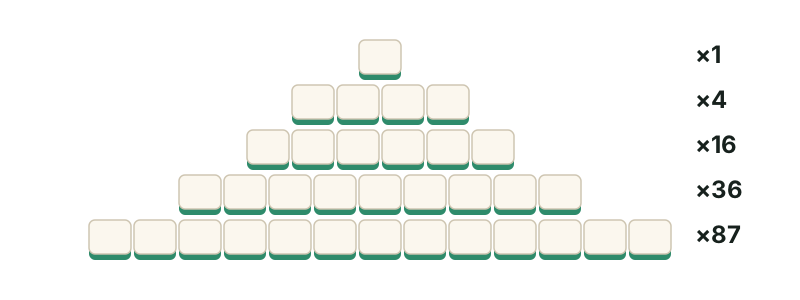
Tiles on upper layers hide the faces underneath them. Clearing the top early reveals information you need in order to plan, which is why experienced players open the stack before working the flat rows.
The base layer is where boards are lost. Its long horizontal rows put a dozen tiles in a line, and every tile in the middle of such a row stays blocked until the row has been eaten inwards from one of its two ends.
Play Vita Mahjong here while you read
Reading the rules gets you about a third of the way. The board below is the game itself, opened right in this page. Nothing is installed, no account is needed, and every rule above applies to it exactly as written.
Three things are worth doing on this first board. Take the top tile and see the four it was hiding. Find a tile with neighbours on both sides and confirm that it will not respond to a tap. Then clear one long row from its end and watch how many tiles that one removal makes available.
Your first Vita Mahjong game, move by move
The opening of a Vita Mahjong game is close to scripted, because so few tiles are legal at the start. What follows is a sequence that works on any deal of the classic layout.
- Take the tile at the very top. It is free by definition and it exposes the four tiles of the layer beneath.
- Clear those four next when they pair with each other or with anything on the edges. Emptying the fourth layer opens sixteen more faces at once.
- Now stop and read the board before touching anything. Count how many copies of each free face you can see, and where the copies you cannot reach are sitting.
- Work the ends of the long base rows steadily rather than saving them. A row you ignore until the endgame is usually the row that ends the run.
- Whenever two matches are available and only one of them frees a locked tile, take the one that frees. This single preference separates players who finish boards from players who stall with twenty tiles left.
- Finish a board once before you worry about your time. Speed comes from recognising faces instantly, and that recognition only builds through repetition.
Mistakes that end a Vita Mahjong board early
Nearly every lost board can be traced to one of three habits, and all three feel productive at the time.
- Clearing all four copies of a face as two quick pairs off the open edges, when one of those pairs was the only key to a tile buried in the middle.
- Reaching for a shuffle without checking the flowers and seasons. Those eight pair by group rather than by face, so a legal match between two different pictures is the one players most often fail to see.
- Emptying the top of the stack and then leaving the base alone. The upper layers are easy and satisfying, and finishing them without touching the long rows leaves the hardest half of the board for last.
Questions about how to play Vita Mahjong
- How do you play Vita Mahjong for the first time?
- Take the single tile crowning the stack, then the four tiles it was sitting on. Those five removals are legal on every deal and they open the middle of the board, which is where the rest of the game is decided.
- Why can I not take a tile with nothing on top of it?
- Because the rule has two halves. Nothing may cover the tile, and one of its two long edges must also be clear. A tile in the middle of a row, with neighbours pressed against both ends, stays locked however open the space above it looks.
- Can two tiles that look different be a match?
- Yes, in two groups only. The four flower tiles all match each other and the four season tiles all match each other, so a plum pairs with an orchid and spring pairs with winter. Every other tile needs an identical face.
- How many tiles are in a game of Vita Mahjong?
- A full board holds 144 tiles: 108 numbered tiles across the three suits, 16 winds, 12 dragons, four flowers and four seasons. They are dealt as 72 pairs, so the deal never leaves a tile without a possible partner.
- Is every Vita Mahjong board possible to finish?
- Not once you have started making choices. A board dealt so that a winning order exists can still become impossible, because clearing two copies of a face can strand the other two under a stack that only those copies would have opened.
- Do I need to download anything to play Vita Mahjong?
- No. The board on this page runs in the browser with no installer and no account. The phone app is a separate thing: download Vita Mahjong if you want offline play and saved progress.
Once the rules are second nature, the next thing to read is the Vita Mahjong tips and strategy guide, which covers the harder boards this page only gestures at.