Vita Mahjong Tips and Strategy
Ninety-seven boards in a hundred can be cleared, so a loss is almost always a move rather than a deal. The habits that prevent it — and a board on this page to try them on.
Updated
Why most Vita Mahjong boards are lost, not dealt
A board that ends with forty tiles stranded feels like a bad deal. It almost never is. An analysis of ten million games of the classic turtle layout found that only about three percent of them cannot be solved even by a player allowed to look under every tile. The rest were winnable when they were dealt, so a loss is nearly always a move rather than a misfortune.
That does not make the game easy. Deciding whether a board can still be cleared is NP-complete even when you can see under the stacks, and nobody is calculating that at the table. What works instead is a few habits that are right far more often than they are wrong.
The arithmetic is small enough to memorise. Four copies of every face means two pairs of every face, so the deal itself never leaves a tile without a possible partner. Every orphan at the end was made by a player.
- Tiles on a full board
- 144
- Matches to make
- 72
- Copies of each face
- 4
- Layers in the classic layout
- 5
- Deals with no solution
- about 3%
The Vita Mahjong tips in short
Seven habits carry most of the difference between stalling and finishing. Each has its own section below.
- Find all four copies of a face before you remove any of them.
- Never spend both loose copies of a face whose other two are stacked.
- Prefer the match that frees something to the one that only shortens a row.
- Eat the long base rows from their ends, from the opening onwards.
- Treat flowers and seasons as ordinary tiles, because that is what they are.
- Read every free tile once more before you spend a shuffle.
- Plan the last twenty tiles backwards, from the pairs that have to happen.
The board halfway down this page is playable, if you would rather test them than read about them.
Count the copies before you take a pair
When three or four copies of a face are visible, look at where all of them sit before you remove any. Two copies taken together are safe only if the remaining two can still reach each other — a question about position, not about how tempting the match looks.
One arrangement kills boards more often than any other. Two copies of the same face are sometimes dealt directly on top of one another, and those two can never clear each other: the lower one is blocked for exactly as long as the upper one is there, and the upper one cannot leave without a partner.
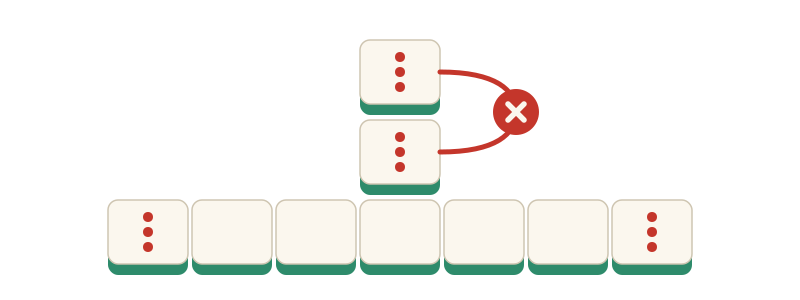
The correct play is to spend one loose copy on the tile at the top of the stack, which uncovers its twin, then spend the other loose copy on the twin. Take the two loose copies as a pair with each other and the board is already lost, however many moves you make afterwards.
The general rule is a question worth asking on every move: after this match, what will the other two copies pair with? Safest of all are pairs whose remaining copies are buried in different stacks, since those surface independently.
Open the board rather than shorten it
Every removal does one of two things. It either makes new tiles available, or it merely reduces the count. Both look identical while you are making them, and only the first is progress.
A tile becomes available when nothing covers it and one of its long edges is clear. So a match that lifts two tiles off the top of a stack hands you whatever was underneath, while a match on two tiles sitting alone hands you nothing. Same two tiles gone, completely different board.
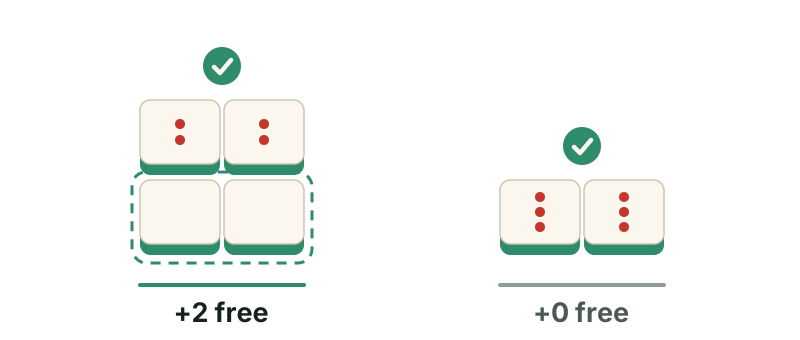
When two matches are available and only one of them frees something, take the one that frees. Removals that uncover are worth a little more than removals that unblock sideways, because a covered tile hides its face as well as locking it in place.
Work the long base rows from both ends
The base layer of the classic layout holds 87 of the 144 tiles, much of it in long horizontal rows. A tile in the middle of such a row has neighbours against both of its long edges, so it stays locked however much empty space sits above it. The only way in is from one of the two ends.
That makes long rows the slowest thing on the board: reaching the middle of a twelve-tile row takes five removals from one end before the sixth tile is even legal. A row you ignore until the endgame is usually the row that ends the run.
So chip at them throughout the game, and work both ends rather than eating steadily from one. A row opened from both sides gives you two live tiles instead of one at every stage.
Flowers and seasons are not wildcards
Most strategy advice for this game says to save the flowers and seasons because they are flexible. The arithmetic does not support it. The four flowers all match each other, which is precisely what four copies of the five of bamboo already do. A flower has three possible partners; so does every other tile on the board.
They do cause two mistakes, and both come from the pictures rather than the rules. The first is spending them the moment they appear, on the feeling that they are free money. Taking two flowers strands the other two exactly as taking two dragons would.
The second is missing them. Two identical dragons catch the eye across half a board, while a plum and an orchid eight tiles apart do not look like a match at all. So scan for them deliberately rather than hoarding them: when the board seems to have run out of moves, that is usually where the match you overlooked is.
Practise these Vita Mahjong tips on a real board
Reading about tile counting does very little on its own. The board below is the game itself, opened right in this page. Nothing is installed and no account is needed.
Three exercises beat another page of reading. Pick a face with three copies showing and find the fourth before you touch it. Take one match that uncovers a tile and one that does not, then watch how differently the board reads a few moves later. And when you next believe there is nothing left to take, count the flowers before you accept it.
When a shuffle is worth spending
Most versions of this game reshuffle the remaining tiles once no exposed pair is left anywhere. It is worth taking at exactly that moment and almost never before, because a board with no legal move is worth nothing and a shuffle therefore costs you nothing you still had.
Before you take it, read every free tile one full time. Missed matches are common on crowded boards, and a match you overlooked is cheaper than a shuffle, which randomises what is left and can hand you a worse arrangement than the one you had.
What a shuffle cannot do is undo the mistake that caused the dead end. If two copies of a face were stranded twenty moves ago, the tiles move but the same number still has to come off in pairs. Treat it as a rescue, never as part of the plan.
Playing the last twenty tiles
Under about twenty tiles the board is small enough to plan exhaustively, and that is the moment to stop playing move by move. Every face still present has two or four copies left, each of those pairs has to happen, and the order is the only thing you control.
So work backwards. Find each face with two copies left and confirm that both can be free at the same time. If one sits directly on the other, the board is already lost. If one is buried under a tile that can still be removed, that removal is not optional — schedule it rather than hoping for it.
The common late error is spending a match that was somebody else’s key. There is usually one tile whose removal is the only route to two or three others, and taking it early for a quick pair is what leaves the last six unreachable.
Questions about Vita Mahjong tips and strategy
- What is the single most useful Vita Mahjong tip?
- Before you remove a pair, find the other two copies of that face and decide what they will pair with. Almost every board that dies with tiles still on it was killed by a match that looked free and quietly orphaned two tiles.
- Why are there no moves left when tiles are still on the board?
- Because a match needs two tiles that are available at the same moment. Tiles can remain in numbers and still be unreachable: buried under a stack, boxed in on both long edges, or paired only with a copy sitting directly underneath them.
- Is every Vita Mahjong board winnable?
- Nearly. About three deals in a hundred of the classic layout have no winning order at all, even for a player allowed to look under every tile. The other ninety-seven can be cleared.
- Should I use the shuffle button?
- Use it when no legal match remains anywhere, because at that point the board is worth nothing and the shuffle costs nothing. Do not use it because the board looks awkward — a missed match is far more common than a genuine dead end.
- Do flowers and seasons match each other in Vita Mahjong?
- Flowers match flowers and seasons match seasons, so a plum clears with an orchid and spring clears with winter. The two groups do not mix, which means each of those eight tiles has exactly three possible partners — the same as every other tile.
If any of this assumed more than you wanted it to, the guide to how Vita Mahjong is played covers the rules from the first move — and if the game will not start at all, try the loading fixes.